
Search The Site
Try a different word, or check the spelling.
Commercial Flood Insurance
Prepare your business for rising water with flood protection for the premises and contents you depend on.

- In short
- Commercial flood protects selected physical property, not automatically the income lost while you repair it.
- Who or what is protected
- The insured business’s eligible building and contents interests when each coverage is purchased.
- Where it stops
- NFIP commercial coverage excludes business interruption; contents do not come automatically with the building.
Separate flood damage from the cost of being closed
This guide helps you distinguish insured physical flood damage from business interruption and identify building and contents selections.
Policy background and wording
Commercial flood insurance addresses direct physical loss to insured business property caused by flood as defined in the policy. A commercial property policy or BOP commonly excludes flood; buying those policies does not by itself close that gap.
For eligible non-residential property, the National Flood Insurance Program (NFIP) General Property Form offers building coverage up to 500,000 dollars and contents coverage up to 500,000 dollars, purchased separately. These are commercial NFIP maximums, not household limits and not a promise that every item is insured. “Personal Property” on this form means business contents, including eligible stock.
NFIP General Property losses are settled on an actual cash value basis, subject to limits, separate building and contents deductibles, exclusions, and other conditions. Private flood or excess flood options may have different terms; ask what is available for the location without assuming broader coverage.
The NFIP definition concerns qualifying inundation of normally dry land, not every water loss. A burst pipe, roof leak, or sewer backup unrelated to a flood needs a different coverage review. Check effective dates and any waiting period before relying on a new policy.
Water damage is not one coverage category
Flood, pipe leaks, and sewer backup can have different definitions and exclusions. Identify the cause before looking for the responding form.
Who typically looks at it
- Owners of business buildings exposed to surface-water or river flooding
- Tenants whose inventory, machinery, or improvements could be damaged by flood
- Businesses reviewing lender requirements, flood maps, and limits across several locations
How it works
After rising water, separate the losses
One flood can create building damage, damaged stock, and a shutdown. They do not share one automatic response.
Read the diagram as text
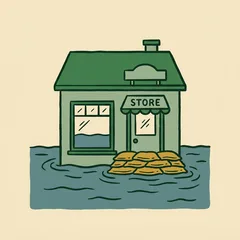
- River overflow damages the insured walls: Building flood coverage (Eligible structure and installed systems).
- Flood ruins the tenant’s inventory: Contents flood coverage (Separately purchased business property).
- Sales stop during flood repairs: Separate income review (Not insured by NFIP General Property).
- A pipe bursts without a flood: Other water-damage review (Not automatically a defined flood).
Terms on this page
- Flood
- A policy-defined inundation, not a label for every kind of water damage.
- Business contents
- Eligible business personal property, including stock, separately insured from the building.
- Actual cash value
- A valuation basis that accounts for depreciation; used by NFIP General Property.
- Excess flood
- A separate layer whose attachment and terms must be checked, not assumed to match the primary policy.
Look deeper
Whose inventory is covered in leased space?
The landlord’s building coverage does not automatically cover a tenant’s stock.
What to check: Identify ownership, the named insured, and the selected contents coverage for the location.
Would ordinary business income pay after a flood?
Do not assume it would. Its covered-cause trigger and flood exclusion matter; NFIP itself excludes business interruption.
What to check: Ask whether any form expressly covers flood-related income loss and under what conditions.
NFIP commercial terms and private-policy questions
The NFIP column concerns eligible non-residential General Property coverage, not household coverage. Private terms are questions to verify, not promised benefits.
| NFIP commercial General Property | Private or excess flood review | |
|---|---|---|
| Building and contents | Separate purchases; up to 500,000 dollars each | Check available limits, insured property, and any layer attachment |
| Valuation | Actual cash value, subject to policy terms | Check actual cash value or any replacement-cost conditions |
| Lost income | Business interruption and loss of use excluded | Ask whether expressly included; never assume |
| Deductibles and timing | Separate building/contents deductibles; check effective date and waiting period | Check deductibles, waiting periods, and binding restrictions |
| Restricted property | Basement, outdoor, and other property restrictions | Read exclusions and sublimits rather than assuming broader terms |
Scroll sideways to compare all columns.
What it may cover, and where it stops
Exact terms depend on the carrier, policy form, endorsements, and applicable law. Review the wording with your agent.
May cover
- Direct physical flood damage to the insured building and eligible installed systems when building coverage is purchased.
- Eligible business contents, machinery, furniture, and stock when contents coverage is purchased.
- A flood-caused sewer backup if it meets the form’s flood and causation requirements; an ordinary backup is different.
Commonly excluded or limited
- NFIP commercial flood coverage does not insure business interruption or loss of use. Do not assume a property business-income form covers a flood shutdown either.
- Building coverage does not automatically include contents. Each has its own selected limit and deductible.
- NFIP General Property uses actual cash value, including depreciation, rather than automatically paying full replacement cost.
- Basement property and certain outdoor property are restricted. Currency, precious metals, recorded data, and most vehicles are not insured under the NFIP form.
- Damage must meet the policy definition of flood. Maintenance problems and other sources of water are not automatically flood losses.
- Limits, waiting periods, and effective dates matter. Private and excess policies need their own review and do not automatically mirror NFIP terms.
Working through an example
Hypothetical and for illustration. Whether a real loss is covered depends on the facts and the policy.
- What happens
River water enters a shop
River overflow damages a shop’s insured building and stock, and the owner closes during repairs.
- Which part is relevant
Purchased building and contents flood coverages address their respective eligible physical losses. NFIP does not pay the lost sales.
- What could change the outcome
- Does the event meet the policy’s flood definition?
- Were both building and contents insured at this location?
- How do actual cash value, limits, and separate deductibles affect payment?
- What funds or separately arranged coverage address the shutdown?
Other situations
A tenant loses stock
Surface flooding damages merchandise in leased premises. The landlord’s building policy does not automatically insure the tenant’s stock. The tenant should review its own contents coverage, location, and storage arrangements.
The doors stay closed
Flood repairs stop sales for several weeks. The NFIP policy does not pay business interruption. Any private flood income protection or other income form must expressly address the flood exposure and its own triggers.
Before you talk to an agent
What underwriters usually weigh
- Building location, flood exposure, elevation, and construction details
- Building and contents values, occupancy, and storage levels
- Prior flood losses and mitigation measures
- Selected limits, deductibles, valuation, and any private or excess layer
Other questions owners ask
Is commercial flood the same as household flood insurance?
No. This guide concerns business property. The NFIP General Property commercial limits and valuation described here should not be replaced with household limits or dwelling settlement rules. Confirm the correct form and occupancy for each building.
Can a business tenant buy flood coverage?
Eligible tenants can review contents coverage for business property they own. Identify improvements, stock, and machinery, and compare the lease with the policy. A landlord’s building coverage is not a substitute.
Does a lower-risk flood zone mean there is no exposure?
No. Flooding can occur outside high-risk zones. Review the address, drainage, and loss history rather than treating a map designation as a guarantee. Lender requirements are a separate question from the amount of protection you need.
Will flood insurance replace lost sales?
Not under the NFIP General Property Form. Private flood income protection, if available, must be specifically reviewed. An ordinary business-income form does not automatically remove its flood exclusion.
Can I buy it just before a storm?
Do not assume immediate protection. Ask about the effective date, waiting periods, exceptions, and any binding restrictions. Plan the review before flooding is imminent.
Talk through commercial flood insurance with an agent
We compare carriers, explain the wording, and help you choose limits that fit how your business actually runs.